



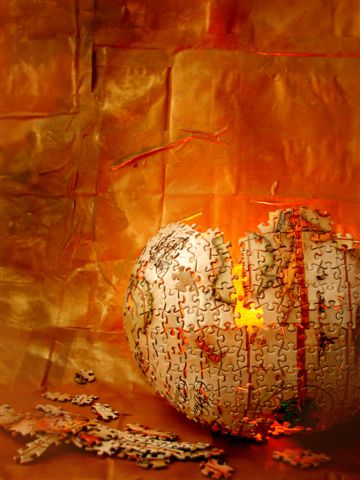


The mission of TGD is to
connect with every corner
of this remarkable world.
connect with every corner
of this remarkable world.
 | |  | |  | |  | |  |
| Passages from Dialogue in a Broken, Connected World, including: *9/11 and the moment of global unity *Osama bin Laden’s home in Afghanistan *The inexplicable shift to Iraq *The Bush “preemption” doctrine *Defeating al Qaeda and making a more credible American policy *The essence of the Israeli-Palestinian conflict *Excerpts from interviews of 3 Jewish Americans who survived Nazi occupation *Dialogues related to the Israeli-Palestinian conflict *Changing the cycle of conflict in Afghanistan *Dialogues related to the conflict in Afghanistan Beneath these passages from the book an archive of Common Sense columns and TGD Analysis will be maintained. The book starts with a quote from Micah, considered a prophet by Jews, Christians and Muslims: “Do justice and love kindness, and walk humbly with your God.” How the reaction to 9/11 inspired this book and showed a more beautiful side of our world: “There were also some inspirational actions and reactions in America and around the world in response to this terrible attack. No American watching these events will ever forget the fact that hundreds of fireman charged into the eye of the disaster, running up the stairs toward the fire. From around the world there were expressions of solidarity and shared grief. There were piles of flowers and notes left at U.S. embassies in London, Paris, Berlin and Tokyo. In the weeks that followed Muslim religious leaders condemned the attack in their sermons. There was a spontaneous candlelight vigil in Tehran before it was broken up by the authorities. In Tehran there was also a moment of silence to reflect on the 9/11 attacks at a soccer game attended by 15,000 people. There is a wonderful photo gallery showing how the first anniversary of 9/11 was remembered at http://www.cleveland. com/911_galleries/ There is a photo of a Japanese girl praying next to a miniature model of the Twin Towers, and another photo shows a French girl wearing an American flag bandana in her hair laying a bouquet of flowers at the U.S. embassy. One year after the 9/11 attacks nearly 200 choirs in 28 countries and on all seven continents sang Mozart’s Requiem in every time zone at 8:46 a.m., the time of the first attack, in what was called The Rolling Requiem. Mozart’s symphony, written as he was dying with the haunting words describing God’s final judgment and imploring “et lux perpetua luceat eis” or “and let perpetual light shine on them” was an immensely moving and appropriate tribute to those who died. Most of the focus after 9/11 was on dissecting the underlying methods, intentions and motivations of the people who would do such an act. Why would this group Americans came to know as al Qaeda want to do something like this? What do they want? Should we give them what they want? Or are they seeking to divide our world so they can claim for themselves the mantle of leadership over the worldwide Muslim community? Is al Qaeda seeking to promote their agenda by attaching themselves to sources of resentment in U.S. policy? If that is their goal, how can America prevent the world from becoming polarized and allowing rising resentment toward our policies to benefit al Qaeda? I have known Muslims my entire life, and though I had some ideas about where to begin looking for answers, I was not sure where the search would finally take me.” Osama bin Laden’s house in Afghanistan (photographs are in book and on “Windows” page): “My first question was, where were Osama bin Laden’s strongholds in Afghanistan during the war with the Soviets? The name of one eastern province on the Afghan border with Pakistan was referred to in the documents I researched over and over again. Within days I had my answer and more… much more. Every person who goes shopping for a new house sees photos of the house to help them decide whether they really like it. What I found looked just like those kinds of photos, only they were of Osama bin Laden’s house in Afghanistan I stared at the screen in stunned disbelief. What I saw were photos of a modest two story concrete structure built into the side of a mountain in the Afghan province of Paktia in a district called Zazi. There is a part of the Afghan-Pakistani border that looks like the shape of a nose. Zazi, Afghanistan is exactly on the tip of that nose. There were caves and tunnels nearby that were also photographed. Everybody with any experience in online research knows that there are millions of hoaxes found throughout the internet. Having said that, perhaps because I am an optimist or perhaps because the photos looked so authentic, I had very little doubt that what I was looking at was real. The photographer was an Afghan man,... and he took the photos while traveling across the border from Pakistan to Afghanistan in May, 2000. That was 16 months before the attacks on 9/11. I contacted a well-known expert on the geology of Afghanistan to have him examine the photographs. He verified that they seemed authentic. By October 22, 2001, I shared these photos with the FBI and the CIA. Two months later, in December, 2001, Osama bin Laden was cornered in the final battle of the war in Afghanistan in Tora Bora., just a few miles away from that house and in the same mountain range known as the White Mountains.” How American leaders missed Osama bin Laden, and inexplicably shifted to Iraq: “Even though Osama bin Laden, the greatest threat to American security, was cornered at Tora Bora, our leaders’ misjudgment allowed him to escape. Unfortunately, this was the first in a series of decisions which took the focus off of al Qaeda. The priorities of our national security became too diffuse, reducing our resources and our effectiveness in Afghanistan and concentrating on Iraq, which by any reasonable analysis did not pose an imminent threat. Saddam’s regime had no missiles capable of hitting Tehran, Riyadh or Tel Aviv, much less Washington, DC, New York or Los Angeles.4 Although many in Washington suspected that Saddam had WMD programs, there was no concrete evidence on which to base this assumption. But members of the Bush administration frequently spoke of Saddam’s WMD and his connection to al Qaeda with a degree of certitude that, again, had no concrete evidence to support it. In an address to the Nashville convention of the Veterans of Foreign Wars, Vice President Cheney’s words left very little room for doubt. “There is no doubt that Saddam Hussein now has weapons of mass destruction,” Cheney said. “There is no doubt that he is amassing them to use against our friends, against our allies and against us.”5 Captured al Qaeda members have told CIA interrogators the idea of collaboration between al Qaeda and Saddam was rejected by Osama bin Laden when his lieutenants raised it, the New York Times has reported.6 A document found with Saddam Hussein when he was captured warned his supporters to be cautious when dealing with fighters that came from outside of Iraq.7 Clearly, the threat of Iraqi WMD and of it being provided to al Qaeda was vastly overstated by the Bush administration. When weighing the cost of shifting our focus from al Qaeda to Iraq we must always remember this grim statistic: Acts of terrorism by al Qaeda against two American embassies, the U.S.S. Cole and the World Trade Center have cost over 3,000 lives. In contrast the regime of Saddam Hussein has never assaulted American institutions except during the two wars that have been fought in the Persian Gulf. Saddam has been contained since 1991, but al Qaeda has aggressively sought to kill Americans all around the world. Choosing to make Saddam Hussein a higher priority than Osama bin Laden and al Qaeda was an incomprehensible misjudgment. But officials from the White House kept pushing to shift the focus from al Qaeda to Iraq. In the Senate Intelligence Report that was published in July, 2004, Democrats referred to Richard Kerr, a former CIA official who examined the Iraq intelligence lapses. Mr. Kerr was said to have told investigators that the White House made numerous requests for information linking Iraq to al-Qaeda terrorism and that created significant pressure on the Intelligence community. Senators Jay Rockefeller, Carl Levin, and Dick Durbin wrote in the Democrats portion of the intelligence report that the CIA's ombudsman “said he felt the ‘hammering’ by the Bush administration on Iraq intelligence was harder than he had previously witnessed in his 32-year career.”8 An allegation of an Iraqi attempt to gain nuclear material in Africa was even described in President Bush’s 2003 State of the Union eleven months after former Ambassador Joseph Wilson, a top Africa expert, had submitted his assessment that the reports of such Iraqi attempts were false.9 In a New York Times commentary, Ambassador Wilson pointed out that the administration knew that the information was false prior to the speech. Eight days later, information reportedly leaked by White House officials to six different journalists included the name of Ambassador Wilson’s wife as well as her occupation as an agent of the CIA in a clear violation of U.S. federal law.10 This level of coercion was used to prevent an independent voice like Ambassador Wilson’s from weakening the case for public support of a war with Iraq that the Bush administration had been planning since its first week in office.”11 The Bush doctrine of pre-emptive war: “The concept of “pre-emptive war” is really not all that new or unusual. America has reserved for itself the right to attack nations that acquire the ability to attack us since the October missile crisis with Cuba in 1962. But what makes the Bush policy of pre-emptive war different is its ethereal nature: Unlike the October missile crisis in which photographic evidence of the nuclear missiles was provided, the Bush administration’s policy claims for itself the right to attack even if there is no concrete evidence of WMD or missiles. The mere possibility that such Iraqi WMD exists, coupled with the mere possibility that at some point al Qaeda and Saddam might some day collaborate – even with no solid evidence that they have any intention or desire to do so – is sufficient justification for the Bush administration’s policy of pre-emptive war. Such a policy is an astonishing assertion of disrespect for the sovereignty of other nations, and is therefore offensive to every nation of the world. If American policy continues down this path the tool of international diplomacy will be lost, and that will be a huge victory for al Qaeda. This policy is also contrary to the traditional American value of respect for the rule of law. If there is a new policy that America can attack other nations without any tangible evidence of their being a threat to our security then we have crossed the very dangerous threshold from a nation whose foreign policy is based on law to one whose policy is veering toward global quasi- hegemony. Using the combination of unsubstantiated justifications of American security and a perversion of the American desire to promote our democratic ideals, this policy of global quasi- hegemony can be used to lead us into a series of wars.... No president should have that degree of power to initiate war without hard proof, and particularly not one who has shown such bad judgment thus far. What makes this policy of justifying war with no concrete evidence of a threat, and of global quasi- hegemony, even worse is the overwhelming likelihood that it will fail to promote any legitimate measure of American self-interest. If America turns every potential threat into a justification for war we will lose arguably our greatest asset, the good will we have earned within the international community and the admiration of people in every nation. Our allies will not help us if we jump into a war of choice again. If there is another attack on a third Muslim country, which prior to these words being written has already been described as under consideration by members of the Israeli government,19 it is very possible that the American-promoted regimes in Afghanistan and Iraq, or even the governments of nuclear-armed Pakistan20 or oil-rich Saudi Arabia could be toppled. The Bush administration’s aggressive approach toward states with the potential of developing nuclear weapons, coupled with its invasions of Afghanistan and Iraq, is also having the opposite of its intended effect. Iraq had no nuclear weapons and it was attacked, while the administration is taking the approach of negotiating with the government of North Korea, which already has nuclear weapons. Ray Takeyh, a senior fellow for Middle Eastern studies at the Council on Foreign Relations said that we are sending the government of Iran a bad message: “You’ve got to become North Korea, or you will be Iraq. Biological and chemical weapons don’t deter the U.S. military and are no guarantee of territorial integrity or sovereignty. But nuclear weapons have a bargaining utility.”21 Vali Nasr, who is a Middle East expert at the Naval Postgraduate School said Iran has, “come to believe, rightly or wrongly, that they’re more likely to manage a threat to the regime if they have a nuclear capability.”22 The terrible ironic effect of the Bush policy of starting a pre-emptive war in Iraq to curtail a nuclear program that did not even exist there, is that America now has limited its options for dealing with the real nuclear programs in Iran and North Korea. In Iran the current Islamic regime is very unpopular, but the nuclear issue provides the leadership there with an opportunity to develop unifying nationalist sentiments. Nasr added, “This issue’s viewed [in Iran] the same way it is in India and Pakistan. It’s a source of national prestige.”23 This comment reminds me of when I was in college and several of my Pakistani friends had signs on their doors that read, “Pakistan go nuclear ” All of my friends were moderates who wanted peace and democracy for their country, but the nuclear issue was a unifying nationalistic rally cry for them. They also knew that the rival on their border, India, had already succeeded in developing nuclear weapons. Similarly, it is predictable that an otherwise unpopular regime like the one in Iran will use nationalism and the threat of a culturally and religiously alien power with military forces on both its eastern and western borders to drum up internal support. Shirin Ebadi, a human rights advocate and lawyer in Iran who won the 2004 Nobel Peace prize said that the U.S. invasion of Iraq made her work for human rights much harder. She explained, “Under slogans such as protecting national security or fighting terrorism, there’s always a reason to act and silence human rights activists. So the U.S. military attack on Iraq… hurt the democracy process in Iran and in the region.” 24 By increasing regional tensions through wars in both Afghanistan and Iraq, the Bush policy has made preventing the Iranian regime’s pursuit of nuclear weapons more difficult and has made that government’s suppression of human rights and the democracy movement there much easier. Understanding al Qaeda and restoring American credibility: “The key to understanding al Qaeda is in Osama bin Laden’s 1998 fatwa ” urging war against Americans that was published in the London newspaper Al-Quds al-'Arabi in Arabic.32 This was a calculated political document. There are no references to using suicide attacks because that would be offensive to most Muslims. The three issues which the 1998 fatwa selects as the basis for war are widely supported by a huge majority of Muslims: 1. American forces on the sacred land of the Arabian peninsula – Saudi Arabia – resonates, especially with conservative Muslims, because Mecca, the holiest city for Muslims, is there; 2. The condemnation of the sanctions against Iraq, that resulted in many Iraqi deaths, also appeals to a large majority of Muslims; and 3. Israeli mistreatment of Palestinian Muslims and control of the holy city of Jerusalem, with political and financial assistance from America is very offensive to most Muslims. Every day millions of Muslims all around the world turn on their televisions and see Israeli human rights abuses against Palestinians, and their respect for America shrinks. This fatwa sheds light on the political nature of al Qaeda’s goals. In the near future al Qaeda will seek to establish political control of one or more Muslim nations preferably one’s with considerable oil revenues such as Iraq or Saudi Arabia. The invasion of Iraq was tailor-made for al Qaeda’s political objectives. The most troubling problem is not so much al Qaeda’s vision of the future, but the lack of vision that American policies have shown in the Middle East. We are conceding the high ground of political legitimacy by default. Because of our policymakers’ very protective view of the Middle East’s oil resources the American ideals of democracy and human rights have played practically no role in shaping American policies there. Ask yourself, “How firm has the U.S. government been in insisting that Israel, our largest aid recipient, withdraw from settlements on Palestinian land that every nation in the world, including the U.S., agrees are a violation of the Geneva Convention on Human Rights?” Or ask yourself, “How often have American leaders tried to promote elections in Saudi Arabia?” Why didn’t the first President Bush invest American resources to avoid the civil war in Afghanistan that lasted five years after the Soviets withdrew, and resulted in the Taliban gaining power there? If American policies had been less consumed by our [short-term] self-interest, and more influenced by our own values, it is reasonable to believe that most of the Middle East and the world would be saying, “Osama who?” Our policy of supporting corrupt dictators, not democracy, and supporting the illegal Israeli [settlements] on Palestinian land in the West Bank and Gaza, not international law and human rights, is devastating to our credibility. When American leaders speak of bringing democracy and freedom to the Middle East most Arabs scoff bitterly.” Excerpts from Chapter 4: The essence of the Israeli-Palestinian conflict "Proportions are also relevant; according to the Israeli human rights group Btselem the civilian casualty rate between January 1, 2000 and May 31, 2003 was: *The number of Israeli civilians killed by attacks in the West Bank, Gaza and East Jerusalem was 189. *The number of Israeli civilians killed by attacks inside Israel was 307. *The number of Palestinian civilians killed by Israeli security forces in the West Bank, Gaza and East Jerusalem was 2,033.128 For American policy to be successful in promoting peace, stability and freedom in the Middle East we must be true to our ideals. This means that American policy must support international law and the protection of human rights. If American leaders abandon these ideals then our policy in the Middle East will have no credibility. Pollster John Zogby found that the Palestinian cause was one of the top 3 issues among 90% of the Arabs in every Arab country. He said, “It’s not even a political issue, it’s a bloodstream issue.”106 Lofty rhetoric about democracy and freedom will be perceived as patronizing hypocrisy. Words are easy. Americans need to have policies that show the Middle East and the world that we still believe in our core values that have shaped us as a nation. Many people I have had discussions with about Israeli policies are unsure about Sharon’s intentions. He has mellowed some Israelis have told me. Sharon’s basic intentions of usurping Palestinian land have not changed, and his own words and actions prove it. Yes, Sharon has made a big show of his conceding that Israel must withdraw from Gaza, where 8,500 Israeli settlers live with 1.3 million Palestinians, but he has said that he believes that by doing so he is heading off international peace initiatives such as the Saudi Peace initiative and the Geneva Accords.107 These peace plans have been supported by former Presidents Clinton and Carter. 108 Sharon has spoken of other “painful concessions which Israel must make in the West Bank, but meanwhile Sharon has been having Israel build a wall that will seize 14.5% of what is left of the West Bank.109 Sharon made it clear as soon as he became prime minister that he would no longer discuss the terms which were on the table at the Taba negotiations. Sharon has said that East Jerusalem is off the table and he has even said that Israel will claim as much as 40% of the West Bank with Palestinian areas of control surrounded by Israeli “security zones.”110 This kind of political setup has been tried before; it was called “Apartheid.” If Palestinians are forced to stay in isolated pockets of land and have no rights to vote in the elections of the government that imposes this political circumstance upon them, how is this different from the homeland system which the South African government imposed on Africans there? Palestinians already live in a two-tiered apartheid-style legal system controlled by the Israeli government. Palestinians are routinely denied the right to create water wells in the West Bank and Gaza, and as a result Israeli settlers have access to several times as much water as Palestinians do. The average Palestinian’s daily water intake is dangerously unhealthy according to the standards of the World Health organization. Palestinians are forced to use different roads then the Israeli settlers, their cars have different license plates than Israeli settlers and the Palestinian roads are monitored by hundreds of Israeli security checkpoints. Israeli policy is to assassinate members of Hamas, Islamic Jihad and the Al Aqsa Brigade, but these assassination attempts usually kill many more Palestinian civilians than the members of the targeted group. Palestinians in the West Bank and Gaza have been regularly subjected to curfews that can be 24 hours a day and last for months at a time. That is exactly what happened to the people of Nablus during most of 2002. Palestinians who live in East Jerusalem are denied the permits to build there and sometimes have been deported because the Israeli government’s policy is to dramatically increase the number of Israelis who live there and reduce the number of Palestinians who live there.112 This is just as illegal under international law as other Israeli settlements in the West Bank and Gaza. Israeli settlements take over land that would have been part of a Palestinian State, so it is a major cause of violence and tension. Every nation in the world recognizes that under international law as described in the provisions of the Geneva Convention on Human Rights it is illegal for a country to resettle members of its own population into a territory occupied as a result of war. Israel gained control of the West Bank, Gaza and East Jerusalem during the 1967 war. Some Israeli settlement expansions have been designed so that they isolate Palestinian cities and towns. Bethlehem and Ramallah, for example, have been cut off from each other in this way by a portion of land from the expanded settlement of Maale Adumim.113 In Hebron , a city of 150,000 Palestinians, people who live there are sometimes attacked by mobs from nearby settlements of less than 2,000. How is that possible, you might ask? Because these settlers are protected by Israeli soldiers, even while they burn Palestinian shops and destroy ancient Olive groves.114 The situation in Israel and the Palestinian territories is reaching a dangerous tipping point. In a few years the land under Israeli control will have a Palestinian majority and if settlements continue to be built the two populations will be entangled beyond any political agreement’s ability to separate. Once this occurs the two sides’ positions will likely harden much more than they already have. Palestinians will insist on their right to vote in the political process that controls their lives, and Israelis will insist on their need to maintain their identity as a Jewish State. New York Times columnist Tom Friedman wrote, “The other people who have not wanted to face facts are the feckless American Jewish leaders, fundamentalist Christians and neoconservatives who together have helped make it impossible for anyone in the U.S. administration to talk seriously about halting Israeli settlement- building without being accused of being anti-Israel. Their collaboration has helped prolong a colonial Israeli occupation that now threatens the entire Zionist enterprise.”122 Mr. Friedman’s criticism is right on target and it would go a long way toward resolving this conflict if moderate Jewish-American and Arab-American groups could find a way of promoting an American agenda for peace in the Middle East. Sharon has made the situation worse, by increasing the number of settlements by about 33% and almost doubling the settler population since becoming prime minister. At a meeting of his cabinet in April, 2002 Sharon slammed his fist on the table and insisted that there would be no discussion of removing settlements until the next election, and if he was re-elected then the settlements would stay even longer.123 There are also enduring problems within the Palestinian leadership which prolong the conflict. Much of the Palestinian leadership, especially Arafat, is corrupt and is also failing to promote peace. Former officials of the Palestinian Authority have said that Arafat is stealing from his own people124 and he also failed to show needed leadership at the Camp David peace talks. Some Palestinians in the West Bank and Gaza refer to Arafat and his almost 40 ministers as “Ali Baba and the forty thieves.”125 Regarding the criticisms of Arafat related to the Camp David negotiations, all of the Palestinian negotiators who were present for these talks have said that Barak’s offer did not address crucial issues such as refugees and the details of the land to be exchanged, and also that the offer was insufficient regarding Palestinian rights to East Jerusalem, ending the presence of settlements in the West Bank and the presence of Israeli soldiers to guard these settlements.126 Israeli negotiators who were present have not contradicted these assessments, but have said that Arafat blocked Barak’ s “generous offer.” The Foundation for Middle East Peace, an independent organization devoted to a just solution to the Israeli-Palestinian conflict wrote in its November, 2000 report: “According to Israel's offer at Camp David, though never clarified, Israel would apparently have surrendered 90 percent or so of the West Bank and Gaza. Yet no settlements would be abandoned. Instead, Israel would annex the majority of them and the others, though nominally under Palestinian sovereignty, would continue to be protected by Israeli forces and connected to Israel by a vast road network. It should not be a surprise that Palestinians view this as confirmation of Israeli conquest and domination which would deny the emergence of a genuinely sovereign, geographically viable Palestinian state.”127 At a minimum, Arafat can still be held responsible for failing to promote a Palestinian counter-offer at Camp David. This would have defended him against the charge that he was refusing to advance the peace process. But in typical Arafat fashion, he was unwilling to define his terms that way. Defining his terms would have meant offending segments within the Palestinian power structure and the one thing which Arafat has never done, is to risk his grip on power. On April 14, 2004 President Bush said, “In light of new realities on the ground including already existing major Israeli populations centers, it is unrealistic to expect that the outcome of final status negotiations will be a full and complete return to the armistice lines of 1949.”131 The President’s described purpose is unnecessary, and the policy shift is an unjust and dangerous demonstration of American bias. The “Israeli population centers” Bush referred to are large illegal Israeli settlements close to the Green Line. In prior negotiations, including Camp David, Taba and the Geneva Accords, both sides had already agreed that the best way to address this issue was through a land exchange in which Israel would keep these settlements close to the Green Line, but would also give up portions of Israel populated by a large Palestinian majority. But Bush has preempted these previously agreed upon exchanges and now has made it his policy that Israel will keep these illegal settlements close to the Green Line and will not have to give up any land in exchange. This was a drastic and unprecedented change in American policy. Never before had any president ever accepted Israeli seizure of Palestinian territories gained as a result of the 1967 war. Bush’s statement contradicts international law and accepted standards of human rights. Clearly Bush is not pursuing a balanced, credible approach to promoting peace in the Middle East. American leaders have not always been good friends to the Palestinian or the Israeli people. A good friend speaks the hard truth even when it might create a temporary rift. Current Israeli policies are not in Israel’s long term interest, and quite the contrary, are leading them toward a demographic shift that undermines their entire existence as a Jewish State. Current Palestinian leadership is not doing anything to reform their political institutions or improve the living standards of their people. An American policy toward the Israeli-Palestinian conflict must be consistent with our core values as a nation such as adherence to the rule of law, human rights, and the rights of freedom and self- determination. Only then can we extend our outstretched hand and attempt to help our friends, the Israeli and Palestinian peoples, free themselves from the bonds of conflict." Excerpts from interviews of 3 Jewish Americans who survived Nazi occupation “ERIC Q: Did it seem as though anti-semitism grew worse after Hitler came to power? A: He was a living perpetrator. The first thing that happened is that the European press and papers in the United States started writing about it, about the arrests that were taking place and so on, and the anti-Jewish measures. And the first thing Hitler did was to organize a boycott of all Jewish shops on April 1, 1933. That was the first rabid anti-semitic measure. Windows were smashed, etc., etc. Kristalnacht was five years later, in November 9, 1938. That was the destruction of the synagogues. Q: This is a painful question. Could you describe some of your relatives that were killed by the Nazis? A: I lost my parents. That’s all I can tell you. Q: What about your extended family? A: My Mother had a sister who fled from France to Switzerland and survived. The rest were all killed. A: I decided that if I can help it I will not go voluntarily on a train, and I did not… I went underground. Q: Would you say that that saved your life? A: Absolutely. I was taken in by a Calvinist reformed minister’s congregation in Amsterdam, in an apartment where I lived for 587 days. I never left the house. Q: Kind of like Anne Frank. A: Very much so. Yes, Anne Frank was a neighbor of ours. I knew her very well. My Mother and Anne Frank’s Mother played bridge every week. Q: It’s unfortunate that she was betrayed the way she was. A: Yeah, but she was not the only one. For five gilders some Dutchmen would deliver you to the Gestapo, and there were quite a few Dutchmen who did it. The people I was with did not. They were very decent people. Q: What did five gilders amount to in U.S. currency? A: Three dollars. A: Helga was underground like me. My Mother arranged before the war that Irene’s sister Helga would come to Holland. She came to Holland and she worked as a maid. Then she was underground and she worked in Amsterdam during the terrible times for a tailor. She would open and close the doors and SS officers would come there to have their uniforms fixed. Q: Oh boy. Very scary. A: Yeah. She had a very hard time. Much harder than I had. Q: She must have been wondering every moment whether they would discover her. A: Well, she didn’t look too Jewish. Q: How about you. Were your features… A: I couldn’t go out, and I did not. Q: Turning to Israel, how did you feel when Israel was first an independent modern State? A: Well I have to explain to you that when I went to Holland I ultimately joined a youth organization for young people like myself (I was a teenager) that was Zionist. Our organization promoted the creation of a State of Israel. I was what is called a Zionist. So the creation of the State of Israel was a great triumph for me. And I married an Israeli. Q: Did you feel a connection to the idea of an ancient homeland of Jews? A: Not really, but I cannot explain this, but in 1951 I was 31 and I flew to Israel. When I we landed in Israel I started crying. Q: So on some level you do feel a strong connection. A: Absolutely, I do. But I am not a nationalist fanatic. I do not like Sharon. Q: Do you believe that it is necessary for Israel forces to be in the West Bank and Gaza? A: The problem is that it is such a small country, the size of New Jersey, that it is very difficult to defend Israel. A way would have to be found, a modus vivendi. Because if you look at the map where most of the Arabs live, the West Bank, is in the middle of the State of Israel. Maybe if the attitude toward defense was constructed more the way that Switzerland is constructed. In Switzerland four different groups live together peacefully. Q:Regarding the relationship between Israeli settlers and the Palestinians who live around them, do you get the impression that the settlers have a level of absolute power that is somehow corrupting them? A: Well I will tell you something. The settlers are mostly Orthodox Jews of Western background, Poland, Prussia or Russia, and they have absolutely no rapport with the surrounding population [of Palestinians]. They are from a completely different world and there is no dialogue. They are mostly arrogant and do not want any contact. It’s a tremendous problem. They are exactly like evangelicals that our friend Bush is so found of. Q: And the evangelicals and the settlers support each other. A: In French they say the extremes touch each other. Q: How did you feel about the Geneva Accord? A: Very interesting, but the guy who did it was not in power. Beilin is a very gifted man and he has very good ideas. Maybe some day he will get the chance to execute some of them. A: What is your book about? Q: It’s about global dialogue. It started with what happened on 9/11. I grew up close to where Irene lives, and there are a lot of Jews who live there. My best friend was a Muslim, and in college I had Muslim roommates. I just felt like there was something that was not connecting. Osama bin Laden was not the impression of Muslims that I had, and Ariel Sharon was not the picture of Jews that I had. There had to be a way to talk this out and gather in other people’s perspective. That’s what I have been trying to do. A: Absolutely. That is very praiseworthy. IRENE Q: When Hitler came to power in 1933, where were you at that time? A: Boarding school in Germany. Q: At what point did you move from there to England? A: I did not go to London until 1938. Q: Before you moved to England you must have seen that the Nazis were pretty scary people. A: My sister and my cousin went underground. Later they were putting people on trains. That was what was so amazing. People would just get on these trains without resisting at all. Eric, my cousin, he absolutely would not get on a train. Q: Where did your relatives live? A: We were in Germany. Later Helga and my cousin went underground in Holland. I went to England in 1938. Q: You were how old? A: Sixteen. Q: When Hitler first came to power, how much did people really understand how much trouble these Nazis might be? A: We did not know. My family was secular and I did not even know that I was Jewish until 4 or 5 years later. Q: So anti-semitism probably wasn’t even on your radar screen. A: Many of the Jews in Germany were secular and had never had any problems with anti-semitism before. That is why they did not resist getting on trains. Q: They probably did not view themselves in contradiction with German society. A: They were arresting people, loading trains and people just went along. My cousin Eric went underground so that he would not have to get on one of the trains. Q: So if he ended up on one of those trains he would have been killed? A: Oh, absolutely. Q: Did his parents die in a Nazi concentration camp? A: Yes. Q: Did you have many other relatives that were killed by the Nazis? A: Everyone that did not leave was killed. Q: How did you feel when Israel first became an independent modern State? A: Well, it was really a great feeling. To see that there were so many people in Jerusalem. I have never felt so safe. Q: Did you feel a connection to the history? To the idea of an ancient homeland of the Jews? A: Not really. The idea was that Jews had a place to be together. Q: One of the settlements is in a place in the West Bank called Hebron. It is supposed to be a significant place in Jewish history because it is where Abraham’s tomb is located. From what you said before, that kind of historical connection is not so important to you; are you more interested in having a Jewish homeland where Jews are a majority? A: Yes. A safe place is what is important. Helga I lived in another house as a nurse taking care of a man who had tuberculosis which was really bad most of the time [after she stopped working in a tailor shop that included German SS as clients ]. I would wash the linens, but by that time there was no soap any more, we only had salt. By that time Amsterdam was occupied and there was nothing in the stores. By 1944 to 1945 the occupation forces took all of the food in the city and there was there was no other food in the city and thousands of people died of hunger. That was one of the coldest winters and we had no electricity. And everybody got half a cup of soup provided by a group kitchen. Once in awhile we had sugar-beets and sometimes we had tulip soup which gave us all terrible diarrhea. Thank God I got a little bit of beans from that household. By pure accident I met some other people who were from the underground and they gave me some potatoes. We had a little Franklin stove and we would cut up wood from furniture or whatever was handy and burn it to boil water. Q: Did you say before that you ate tulip soup? A: Tulip soup once a week was common during that time. The people would go to the farmers and the farmers would not take any money any more. People would walk in groups of ten, twenty or thirty together, through the snow for miles to get to the farmers. They would give the farmers whatever they had to get some eggs or ham. You felt as though you were not the only one because the whole city of Amsterdam, Jewish or not Jewish was in an absolutely awful state. The only warm water I could get was from this man who gave me five gin bottles filled with warm water. And it was dark at night. We had no light, and we had only a few candles. I bought some wicks on the black market and some bril**** [indecipherable] and the wick would float on it and that was my only light. I read Dostoyevsky at that time and that helped me tremendously because I thought that if he could get through something as awful as Siberia, I could get through this too. We all lost an enormous amount of weight, waiting for the war to end and many, many people died of hunger. I had horrible sores on my hands and my nails were black from the lack of vitamins. But surprisingly within a year I was almost back to normal. Q: You mentioned that it took some money to get into the underground. A: Yes, it took some money because people would have to steal some things. They had to falsify the documents. They needed your thumbprint and a photograph to make the false identification papers, which wasn’t that easy. They would steal documents at swimming pools or places like that. There were quite a few young Dutch people who were fighting against the Germans and who tried to disrupt railroads and stuff like that. But we did not know we were Jewish until four years after Hitler came to power. Our parents and our grandparents were not Jewish by faith and so we really did not realize it. In the schools in Germany they had evangelical religious teaching in the curriculum. One of the things they taught you was the Old and New Testaments and we got that all the time and we loved it. Then the neighbors started to go into the Hitler youth and they didn’t want to play with us any more. Q: How did the neighbors know that you were Jewish? A: Because it came out through the government and then everybody knew. Q: Did the Nazi government actually do research into people’s family history? A: Yes, everybody had to document their family background. Suddenly everybody discovered who was Jewish and who was not Jewish, and who had a Jewish grandfather or great grandmother or something. There was a lot of intermarriage in Germany. Our Grandparents had many siblings so that we have oodles of second cousins all over the world: In England, in South Africa, in Israel, some in France and some in Germany. I stay in contact with a lot of my second cousins. Eric is a second cousin. Q: These relatives who still live in Germany, how could they stay in Germany and survive? A: Only one of their grandparents was Jewish, so they could survive. Q: So it was broken down into how many of your grandparents were Jewish? A: Exactly. Q: Oh boy. What a crazy system.” The Miftah Dialogues “Wall protesters shot Mo 12-28-03 I saw this and of course was bitter about Sharon's forces once again slapping down the hand extended in peace. Wall protesters shot JERUSALEM: Israeli soldiers yesterday shot and wounded an Israeli and an American who were among protesters trying to breach a controversial barrier Israel is building in the West Bank, witnesses said. It appeared to be the first time the army had fired live ammunition at Israeli protesters trying to damage the barrier of razor-wire fences, concrete walls and trenches that Israel says it needs to stop infiltrations by Palestinians. http://www.gulf-daily-news.com/ Articles.asp?Article=70059&Sn=WORLD Mo 12-29-03 Israelis, Americans, Palestinians all angry about Israeli troops using real bullets on peace activists protesting at the Apartheid Wall. Maya 12-29-03 I'm trying to process everything that's been going through my head in the last 3 days. I was there, in Mas'ha, cutting the fence, when they started shooting at us. Ever since then, it's been all over the news in Israel - here, we finally got what we wanted, suddenly someone notices our protest after three years of helplessly trying to catch the public's attention. But guess what? Hardly anyone is talking about the fence, nor even about the IOF policy of opening fire at unarmed civilians. There seem to be two main positions regarding what happened: there are the right-wing fascists who claim that the shooting was justified, and the left-wing racists who cry out against the treatment of Israeli demonstrators as if they were Palestinian rioters . But it's far more disturbing then that. After the action I was speaking to a friend of mine, a Palestinian citizen of Israel. Heard the military's response? he asks me. No, I haven’t yet I reply. They say they didn’t notice that the demonstrators were Israeli, so they used the regular routine of opening fire , he says bitterly. *Didn’t know we were Israelis?* I feel like screaming. They knew d*mn well we were fucking Israeli, we were yelling at them in Hebrew like hell: Don't shoot, we're Israeli, stop shooting - then I stop. That's not why he's telling me this. There's something wrong here. What the fuck does it matter if we were Israeli or not? - that is so not the point. They shot at unarmed demonstrators who were by no means posing any risk. Our national identity is supposed to be irrelevant. But of course, it never is. The whole principal of our action was that being Israeli Jews we can afford to hold non-violent direct actions without risking our lives. Palestinians cannot afford to do that, since even the most non-violent show of resistance, like holding a peaceful demonstration, is bound to be brutally handled, using deadly means such as rubber bullets and live ammunition. So we thought we could fit in there. We'd use our ethinc privilege as members of the occupying society and take the form of struggle denied from Palestinians. We worked in coordination with the local Palestinian populations, because we knew they would be the ones who pay the price after we Israelis go home to our comfortable realities. If they were willing to go ahead with it - it was good enough for us. I felt good about it. There we were, working with Palestinians, doing something which I knew was completely illegitimate from the Israeli perspective. Strangely, it felt as if for a moment there we managed to break through the ethnic separation. In Zebuba, where we held a similar action, I felt that for a short while it was no longer Israelis versus Palestinians, it was simply people fighting for liberation against the forces of occupation. But it was nothing but a sweet illusion. It took a few bullets to make me realize that. Once they started shooting at us, we were more than willing to use our ethnic privilege. We were shouting at them to stop shooting, not simply because we're not armed and not posing any risk (though we were shouting that as well) but mainly because we're Israeli, flesh of their flesh , so to speak. 3 years ago, in October 2000, the Israeli police forces have killed 13 Israeli citizens, in demonstrations held within the 48 borders. It's been going on for about a week. The Zionist left said nothing. They were talking about the Arab rioters , blaming the Arab leadership for not restraining the Arab mob - not a word about the police shooting at unarmed civilians. These events, which woke me, and others like me, from our political coma, ended up with an investigation committee whose very moderate conclusions were immediately buried. Now the whole country is in uproar about one Jewish demonstrator being wounded. Mo 12-29-03 Maya, that is one hell of an experience. Thank you for your efforts and be as careful as you can. I do not blame your group at all for trying to use your ethnicity to stop the bullets from flying at you. I am sure your Palestinian friends there understand too. Anybody would have tried that if they were in your situation. The ethnic divide is just another racist wall built by the enemies of peace. Maya 12-29-03 Hi Mo, Thanks for your supportive words. It's not about us rationally using our ethnicity to make them stop. I can't speak for the rest of the group, but I know that I myself was not just thinking: okey, let's let them know we're Israeli because that would make the racist assholes stop shooting . To be honest, I personally didn't shout anything, I was too afraid to speak and just kept cutting and praying they would stop shooting. The thing is that I was actually thinking: How the fuck can they do that? They know we're Israeli. And it was far worse afterwords, when speaking with friends of mine, I kept stressing the fact that they knew. It was only after that conversation I mentioned that I finally realized how distorted it all was. I really don't think I'm racist, but it seems that I've completely internalized the racist rules of the game. And it sure as hell doesn't feel right. michal 12-29-03 The Fence; saves lives. By all accounts. By tearing down the Fence--you are declaring to the terrorists that you ENCOURAGE THEM to murder more innocent Jews. This is not nice. abumiftah 12-29-03 I do like his trend. Salaam, peace, shalom. Peace without Fascists abumiftah hfinnish 12-29-03 Maya,based on this incident you are not a racist. Internalizing the racist rules of the way Palestinians and Israelis are treated is natural when it is the reality you live in. My favorite passage from The Adventures of Huckleberry Finn, which I take my nickname from, describes how Huck Finn encounters the same problem. Huck actually believes that he will go to hell because he has freed a slave That is how far the rules of his society had turned moral perspective upside-down, in ways that adults, much less 12 year old boys, could not understand. This passage is from the chapter called You can't pray a lie : That's just the way. A person does a low-down thing and then he don't want to take no consequences of it. Thinks as long as he can hide it ain't no disgrace. That was my fix exactly. The more I studied about this the more my conscience went to grinding me, and the more wicked and low-down and ornery I got to feeling. And at last, then it hit me all of a sudden that that here was the plain hand of Providence [God] slapping me in the face and letting me know that my wickedness was being watched all the time from up there in heaven, whilst I was stealing a poor old woman's nigger that hadn't ever done me no harm, and now was showing me there's One [God] that's always on the lookout, and ain't a-going to allow such miserable doings to go only just so fur and no further, I most dropped in my tracks I was so scared. Well I tried the best that I could to kinder soften it up for myself by saying I was brung up wicked, and so I warn't so much to blame; but something inside of me kept saying, There was the Sunday School [Christian teaching for children], you could have gone to it; and if you'd a done it they'd a learnt you that people that acts as I'd been acting about that nigger goes to everlasting fire. It made me shiver, and I made up my mind to pray, and see if I couldn't try to quit being the kind of boy I was and be better. So I kneeled down. But the words wouldn't come. Why wouldn't they? It warn't no use to try to hide it from Him. Nor from me neither. It was because my heart warn't right; it was because I warn't square; it was because I was playing double. I was letting on to give up sin, But away inside of me I was holding on to the biggest one of all. I was trying to make my mouth say I would do the right thing and the clean thing, and go write to that nigger's owner and tell where he was; but deep down in me I know'd it was a lie, and He know'd it. You can't pray a lie -- I found that out. [So Huck decided to write the letter first and then see if it would be easier for him to pray to God about it. After he wrote the letter Huck's conscience continued to bother him] It was a close place. I took it [the letter] and held it in my hand. I was a-trembling because I'd got to decide, forever, betwixt two things, and I know'd it. I studied it a minute, sort of holding my breath, and then says to myself: All right then, I'll go to hell -- and tore it up [this is when I grew to love the character of Huck Finn, an uneducated boy who instinctively is drawn to doing the right thing even though he thinks he might spend eternity burning in hell as a result]. It was awful thoughts and awful words. But they was said. And I let them stay said; and never thought no more about reforming. I shoved the whole thing out of my head and said that I would take up wickedness again. Internalizing racist rules that are all around you is very natural. Maya, like with Huck Finn, it is your actions that matter. Take care, John Letter to the enemy by Samir Kasir [With preceding comments from Haaretz where portions of Mr. Kasir’s article were republished] Lebanese journalist Samir Kasir, who closely follows political developments in Israel and knows how to analyze them, Letter to the Enemy, published last weekend in the Lebanese Al-Nahar newspaper. The following is a translation of the main points of that article. Alas, oh enemy. I know that it is not customary for enemies to correspond. However, our enmity is not the usual kind. After a generation in which we refused to reconcile ourselves to the onslaught on Palestine [a reference to the 1948 war - Z.B.], we reached the stage where our countries and our governments accepted the fact that you are no longer an enemy with whom we have an existential conflict, but rather an opponent with whom we have a border dispute. Not everyone accepted that shift and many of us still speak the rhetoric of war. Nevertheless, we have chosen the principle according to which peace is a strategic choice, especially after our countries have all entered into a more complex peace process with you. No commitment This shift became rooted in our minds after extended denial, when you recognized the Palestinian people and with it established a foundation for a historical compromise, which you quickly emptied of all content and withdrew your hand from all your commitments. We soon understood that the peace that we had adopted is not the general consensus among you, but we continued to maintain our choice, while standing guard, and we continued to follow the signals from your direction, in the hope that they would bolster the peace. Thus, great and small among us became experts in your elections laws, your Knesset's amendments and your society's quirks. When the Internet spread and the reading of Ha'aretz and the Jerusalem Post became a daily custom among many of us, and when the number of Arabic-language satellite television stations grew, shattered the mental block and held interviews with Israeli guests, statesmen and analysts, I think we all received a degree in the Israeli political sociology. But woe is that knowledge. What have we gained from it but more loss of direction? The truth is that I should admit to you, oh enemy, a few days before your fateful elections, that I do not understand you. Alas, oh enemy. I know that it is not customary for enemies to speak openly with one another. However, our enmity is not the usual kind. You forced yourself upon us and then went and complained that we are not accepting you, and after we accepted the idea of coexistence with you you became indifferent. I am not saying this only because you are determined to reject the opportunity to renew the peace process - you broadcast contradictory signals, as you did in the previous elections, when you elected Sharon at a time when you claimed you supported peace. Okay, that too I could understand. You are forged from feelings of hatred toward your surroundings and it is difficult to shake off what has become second nature. What I do not understand is that you behave as if you do not know what you want. I am not asking you what you want, I am telling you what you are - you are sick. I know how you will reply. You will probably say that we are the sick ones, and that is true. Our countries are ill and our societies are ill. The difference between us and you is that we recognize our unwell situation while you are behaving haughtily. We understand the risks of our illness to the point that we have taken upon ourselves, as an initial treatment, to amputate one of our limbs; that part of Palestine over which you took control over half a century ago, we operated like a surgeon who knows that refraining from amputating a diseased arm will expose the patient to extermination. We therefore accepted the compromise that will allow us to take care of our person. You did not do the same for yourself because you have still not noticed that you are ill, perhaps more than we. Water: A human right denied Leila -- 03-16-2004 @ 4:11 PM Water: A human right denied This B'tselem report can be found at the website for the human rights group located at www.btselem. org Israel's citizens, like those of developed countries worldwide, benefit year-round from unlimited running water to meet their household needs. On the other hand, hundreds of thousands of Palestinians suffer from a severe water shortage throughout the summer. This shortage of water affects every function that water plays in human life: drinking, bathing, cleaning, and watering of crops and animals. The shortage drastically affects the residents' health and economic well-being. The shortage of drinking water can cause dehydration and the inability to maintain proper hygiene and thus lead to illness. Failure to water crops and animals affects the livelihood of the residents. The water shortage violates the basic human rights of Palestinian residents of the Occupied Territories such as the right to health, to adequate housing, to equality, and to benefit from their natural resources. This harm results from Israeli policy, in effect since 1967, based on an unfair division of resources shared by Israel and the Palestinians. Control over Water under the Occupation: Demand for water by Palestinians in the West Bank and the Gaza Strip has been increasing since the 1920s. The main reason for the increase is, in addition to natural population growth, the increased number of homes connected to a central water network. The demand for water in the Occupied Territories increased at a greater rate since the beginning of the Israeli occupation, in 1967, because of the relative increase in the Palestinian standard of living following integration of the economies of the Occupied Territories and Israel. However, Israel's tight control of the water sector in the Occupied Territories prevented development that would enable the water sector to meet Palestinians' increasing demand for water. Israel instituted restrictions and prohibitions that had not existed under Jordanian and Egyptian control. These restrictions and prohibitions are a principal reason for the water shortage and the resultant water crisis. Israel's water policy in the Occupied Territories benefited Israel in two primary ways: Preservation of the unequal division of the shared groundwater in the West Bank's Western Aquifer and Northern Aquifer. This division was created prior to the occupation, a result of the gap between economic and technological development in Israel as opposed to the West Bank. However, the gap would have likely diminished had Israel not prevented it. Utilization of new water sources, to which Israel had no access prior to 1967, such as the Eastern Aquifer (in the West Bank) and the Gaza Aquifer, primarily to benefit Israeli settlements established in those areas. For residents of the Occupied Territories, the primary result of the change in the law and transfer of powers over the water sector to Israeli bodies was the drastic restriction on drilling new wells to meet their water needs. According to military orders, drilling a well required obtaining a permit, which entailed a lengthy and complicated bureaucratic process. The vast majority of applications submitted during the occupation were denied. The few that were granted were solely for domestic use, and were less than the number of wells that, after 1967, had ceased to be used due to improper maintenance or because they had dried up. It should be emphasized that the legal and institutional changes that Israel instituted in the water sector in the Occupied Territories are not intrinsically unacceptable. They conformed to the approach taken in Israel's water sector and could, in principle, have led to a more efficient supply of water to the Palestinians. However, Israel utilized these changes to exclusively promote Israeli interests, almost completely ignoring the needs of the Palestinian population, which was left to face a growing water shortage. The water crisis in the Occupied Territories resulted not only from the restrictions Israel placed on Palestinian residents, but also from Israel's relatively minimal investment in water infrastructure. The neglect in infrastructure was conspicuous in two areas: in construction of infrastructure to connect rural communities to a running-water network, and in maintenance (to prevent loss of water) of the existing networks. When the Interim Agreement was signed, 20 percent of Palestinians in the West Bank were not connected to a running-water network. The water-pipe leaks resulting from improper maintenance led in some instances to a loss of up to 60 percent of the quantity of water supplied. This was true, for example, in Jenin and Gaza. The Gap in Water Consumption between Palestinians and Israelis The discrimination in utilization of the resources shared by Israel and the Palestinian Authority is clearly seen in the figures on water consumption by the two populations. Per capita water consumption in the West Bank for domestic, urban, and industrial use is only 26 cubic meters a year, which translates into 70 liters per person per day. There is a huge gap between Israeli and Palestinian consumption. The average Israeli consumes for domestic and urban use approximately 103 cubic meters a year, or 282 liters per person per day. In other words, per capita use in Israel is four times higher than in the Occupied Territories. To make a more precise comparison, by also taking into account industrial water consumption in Israel, per capita use per year reaches 128 cubic meters - 350 liters per person a day - or five times Palestinian per capita consumption. The World Health Organization and the United States Agency for International Development recommend 100 liters of water per person per day as the minimum quantity for basic consumption. This amount includes, in addition to domestic use, consumption in hospitals, schools, businesses, and other public institutions. International Law on Water In examining the international law, it is necessary to distinguish between Israel's obligations as an occupying state to the population under its control, and the use of water sources shared by Israel and the Palestinians, which are considered international waters. A. Administration of the water sector in occupied territory 1. Prohibition on altering legislation Article 43 of the 1907 Hague Regulations prohibits the occupying state from changing the legislation in effect prior to occupation. The military orders that Israel issued regarding the water resources and the supply of water in the Occupied Territories significantly changed the legal and institutional structure of the water sector. The water resources in the Occupied Territories were integrated into the legal and bureaucratic system of Israel, severely limiting the ability of Palestinians to develop those resources. 2. Illegal utilization of the water resources Article 55 of the Hague Regulations limits the right of occupying states to utilize the water sources of occupied territory. The use is limited to military needs and may not exceed past use. Use of groundwater of the Occupied Territories in the settlements does not meet these criteria and therefore breaches article 55. 3. Discrimination between Palestinians and Israeli Settlers Article 27 of the Fourth Geneva Convention of 1949 prohibits the occupying state from discriminating between residents of the occupied territory.* The quantity of water supplied to the settlements is vastly larger than is supplied to the Palestinians. Similarly, the regularity of supply is much greater in the settlements. This discrimination is especially blatant during the summer, when the supply to Palestinians in some areas of the West Bank is reduced to meet the increased demand for water in the settlements receiving water from the same pipelines. B. Utilization of the shared international water sources Under international law, the main principle for division of shared water between states is the principle of equitable and reasonable use. This principle is based on the limited-sovereignty doctrine, which provides that, because all parts of the drainage basins of watercourses are hydrologically interdependent, states are not allowed to utilize water located in their territory as they wish, but must take into account the other states that share the resource. This principle does not state a precise formula quantifying the rights of each state sharing an international watercourse. Rather, it lists the factors to be considered in negotiations between the states to determine the division. Article 6 of the UN Convention on the Law of the Non-Navigational Uses of International Watercourses enumerates seven of these factors: *The natural features of the shared watercourse (geographic, climatic, hydrologic, and the like); *The social and economic needs of the watercourse states; *The population dependent on the watercourse in each watercourse state; *The effects of the use of the watercourses in one watercourse state on other watercourse states; *Existing and potential uses of the watercourse; *Conservation, protection, and development of the water resources of the watercourse and the costs of measures taken to that effect; *The availability of alternatives to a particular planned or existing use. Taking into account the components of the principle of equitable and reasonable use, examination of the current division of water between Israel and the Palestinians leads to the conclusion that this division violates Palestinian rights and contravenes international water law. * In spite of a wide international consensus regarding the applicability of the Fourth Geneva Convention to the Occupied Territories, Israeli officials deny the applicability of the Convention, claiming that these are not occupied territories in the legal sense [even though Prime Minister Sharon himself called it an occupation]. This message was edited by Leila on 3-16-04 @ 9:35 PM Passages from Chapter 5 Changing the cycle of conflict in Afghanistan "But the origins of instability go back much farther than this recent history. The cycle of violence goes back at least as far as the overthrow of King Mohammad Zahir Shah in 1973 by his cousin, Mohammad Daoud ,while the King was in Italy. Daoud proclaimed that Afghanistan was a republic and that he was its new president. His forces beat back Islamic resistance to these changes. Then he started to remove socialist government officials from positions of power. In 1978 there was a marxist coup during which President Daoud and his entire family were shot. Nur Mohammad Taraki became leader, but then he was executed and Hafizullah Amin took over in October, 1979. The Soviets were threatened by Amin’s nationalistic views and his bloodthirsty tactics, so they had him assassinated and invaded Afghanistan to install a new leader, Babrak Karmal, who had been the ambassador to Czechoslavakia. During the Soviet occupation about a million Afghans were killed. The Soviets withdrew in 1989, leaving in place the government of President Najibullah. He was ruthless and held onto power for three years after the Soviet withdrawal. In 1992 Islamic forces called the mujahideen, took over Kabul and installed new President and former professor Burhanuddin Rabbani as leader of their new Islamic republic. But different factions from within the mujahideen began fighting for power. This civil war lasted from 1992 until 1997. The Taliban grew from its powerbase in Kandahar. First it won over many of the Pashtun mujahideen leaders; then it took over Kabul in 1996 and by 2001 was in control of 90% of Afghanistan. Support for the Taliban was deepest among the Pashtun, who are a majority in Afghanistan. But there was strong resistance to the Taliban in parts of the country in which the Pashtun were not a majority.133 Former mujahideen Gulbuddin Hekmatyar and other Pashtun mujahideen militia leaders joined the forces of the Taliban, while non-Pashtun militia leaders Ahmed Shah Massoud, Ismail Khan, Mohammed Fahim and Abdul Dostum joined forces with Rabbani to form the Northern Alliance. The civil war was largely divided along ethnic lines in a manner that had not previously occurred during Afghanistan’s modern history. Current President Hamid Karzai had been the deputy foreign minister of the Rabbani government when he was detained by current defense minister and then head of the secret service Mohammed Fahim in either 1993 or 1994 (the exact date has not been confirmed). The interrogation process was suddenly interrupted when a rocket attack from forces loyal to then Prime Minister Hekmatyar provided Karzai with an opportunity to escape.134 This episode from the difficult civil war period shows how Karzai is uniquely qualified to speak to the interests of the people and the powerbrokers of the diverse ethnic groups. He has worked with leaders on both sides before. But what was America’s Afghan policy during this period of Afghan instability from 1989 to 1997? The first President Bush and also President Clinton own a great deal of the responsibility for allowing a power vacuum and civil war to follow the Soviet withdrawal in 1989. Instead of taking proactive steps to influence a stable political process in Afghanistan during this sensitive period, the American policy was to allow Pakistan and Saudi Arabia to provide money and logistics to the Taliban, which eventually led to their control over most of Afghanistan. Pakistan considered their Taliban surrogates in Afghanistan useful for “strategic depth” that would help them deal with India, and Saudi Arabia appeased Islamic conservatives within their own society by exporting the rigid wahabbi form of Islamc beliefs to northwest Pakistan and southern Afghanistan. Even today some believe that elements in the Pakistani government are waiting in the hopes that if bin Laden is captured, America will abandon the region; this would allow Pakistan to once again employ their fundamentalist political surrogates in Afghanistan.135 After 1989, through benign neglect, America allowed Afghanistan to become ravaged by civil war. Then from 1996 to 1997 American policies shifted away from benign neglect and actually began to assist the Taliban. The CIA assisted Pakistan’s intelligence, the ISI, with providing weapons and logistics to help with the establishment of a conservative fundamentalist government in Afghanistan. 136 Why on Earth would the CIA be used to support the Taliban? Author Ahmed Rashid, in his excellent book, “Taliban: Militant Islam, Oil and Fundamentalism in Central Asia,” describes the high stakes international competition for a gas pipeline from Turkmenistan through Afghanistan to Pakistan. He wrote that policy was not being driven by politicians and diplomats, “but by the secretive oil companies and intelligence services of the regional states.”137 The American company Unocal had offices in Pakistan and was persuaded that the Taliban could end the civil war and the stability there would allow them to build the gas pipeline through all of Afghanistan.138 In contrast, the Taliban’ s opponent in the Afghan civil war, the Northern alliance, was supported by the government of Iran. Iran was opposed to a pipeline in Afghanistan, because they wanted to be the conduit of gas that the growing economies in India and China would rely on.139 Therefore, the American policy of supporting the Taliban had a second motivation – to limit the growth and influence of Iran. In 1998 al Qaeda attacked two U.S. embassies in Africa and the Taliban’s continued support for this group caused a dramatic shift in America’s policy in Afghanistan. The three worst possible traits of foreign policy were displayed in recent American actions in Afghanistan and Iraq: 1. Benign neglect – The American policy towards Afghanistan from 1989 to 1996 appears to have been indifference. Why weren’t American leaders pressing for a negotiated end to the fighting and perhaps even a regional conference to mute Pakistani, Indian, Iranian and Russian policies which exacerbated the civil war? 2. Corporate influence: – From 1996 to 1997 America’s interest in creating stable alliances in central Asia was subordinated to corporate interests in a gas pipeline, and also a narrow focus on limiting the growth of Iran. How else can one explain how the CIA was caught up in promoting the Taliban from 1996 to 1997, while the American State department never even recognized the Taliban as the legitimate government of Afghanistan?139 3. A U.S.-created power vacuum: – When Saddam and the Taliban were removed from control of the governments in Afghanistan and Iraq, although the new leaders, Hamid Karzai and Iyad Allawi, were politically legitimate, high quality leaders, there was no postwar plan or resources for maintaining stability outside of Kabul and Baghdad. The Taliban made Osama bin Laden and al Qaeda their honored guests, but our government assisted them for about two years without a clear assessment of who they were. More recently American forces removed totalitarian regimes in both Afghanistan and Iraq with no plan for maintaining security in these societies after the new governments were in place. Incredibly, very little thought appears to have been given to the level of postwar troops and resources that would be required in Afghanistan and Iraq. American foreign policy has to be more forward-thinking than that. It must be understood that power vacuums and political instability within societies that already resent American policies can become breeding grounds for al Qaeda or other aggressive terrorist movements. Current American policy in the Middle East is a source of widespread resentment which can explode if there is no government capable of providing security. Passages from Chapter 5, Section 2 Dialogue with Afghans Terrorism, war and the victims of both: I responded to a message that alleged that the story of the beheading of Nichalas Berg was a fraud: I wanted to respond to the post that alleged that the beheading of Nicolas Berg was a fraud. I can tell you this much: I saw his Father on the news and he was hysterical with grief crying tears that were very real. Zarqawi, Bin Laden, and the rest of al Qaeda are really awful people. Atta wrote back: And so are Mr. Bush and his mercenaries in Afghanistan and Iraq. Let me put it in simple words. A politician orders his army to invade a country, kill at will and slaughter people who resist. Many are killed and slaughtered. Men and women see their loved ones killed brutally. Many of them will take revenge and as they say everything is FAIR IN WAR. Some of them will retaliate in an inhuman way. So the first one is to be blamed is that politician who declared an unjust war on innocent people and then comes the last one. Both have to be cursed in the same way. To me the american soldiers involved in humiliating Iraqi POWS are more sinful than Zarqawi. Zaqawai does not follow any rules while those soldiers were under rules. Atta John: Do you really believe that humiliation is worse than the most brutal murder? Is it worse to have one's throat slashed or to have some naked photos? Do you really believe that ALL is fair in war? Don't parties to a war have a duty to at least try to avoid killing civilians? If that is the goal then isn't the one who slashes the throat of a civilian worse than all others? When the trial and investigation of the soldiers involved in the prison abuse is over several will end up in jail and at least two generals will probably lose their jobs. Rumsfeld should also lose his job, but that probably will not happen. This problem started because there was a decision from Rumsfeld and others that captured al Qaeda are not covered by the Geneva Convention on Human Rights. They then started to ignore these rules for treatment of Iraqi prisoners too. That is wrong. Americans know that is wrong too, and that is why the soldiers involved are being tried as criminals. If Americans can tell that this prison abuse was wrong, I hope that you can tell that slashing an innocent civilian's throat is VERY wrong. Atta: The problem is that you are twisting the words. You yourself say that humiliation is not as grave an act as murder is. I agree. But then you say that loosing a job is a just solution for those acts of disgust ( Read the report carefully and you will know that it was not just humiliating prisoners but there were acts of rape and cold blooded murders). I don't think so. If an american soldier does kill some innocent peson that is right because IT IS WAR. And if a person ( no matter how insane he may be) kills an american then the you condemn him with all it ability( this is hypocracy). The point is both are equally wrong. If a soldier in self defence can kill at will then people being killed will also try to avenge. Every thing fair in war is the cry of Mr.Bush not mine and that is very clear from what he is saying and his army is doing. Iraqi's did not invite Bush to save them. He declared an unjust war on them. Though they don't have weapons to fight back but still they are resisting. So loosing elections or jobs and still enjoy the free air is not equal to being butchered every day. I again say that Zarqavi is as headless and inhuman as Bush or his companians are. Saffy: America went tinto iraq illegally......going in illegally with all their firepower of course innocent people are going to get slaughtered we use fancy language to disguise the killings of Irqis and afghans - colateral damage etc but when an amercan is killed he is murdered, slaughtered. the killers did wrong but the media biases the killing of those with no voice.... Mohammed: US/UK has killed and slaughtered over 60,000 innocent civilians in Iraq (so called, collateral damage). US/UK has killed and slaughtered over 20,000 innocent civilians in Afghanistan (again so called, collateral damage). The number of peaople wounded, made refugees, displaced from their own homes, etc etc in Iraq and Afghanistan is over a million. Whilst I abhor what has been done to the one US civilian, let us get this in perspective. John: When a politician chooses to go to war innocent people will die. I understand that. But is any of us saying that all wars are wrong? No, so that means either war is a bad choice or a good choice. Here I agree with you that this war was a bad choice. But do you think that is the same as standing behind an innocent, tied up, totally defenseless person and slashing his throat? The Iraqi resistance are guerillas attacking American soldiers. That is different. The American soldiers are attacking the guerillas too. Again that is different. Those situations involve combatants attacking combatants. But Zarqawi just took one person who was not even involved in the fighting and slashed his throat. These things cannot be compared. Let me ask you to compare these two situations: 1. A group of guerillas fire their weapons at some soldiers and the soldiers fire back, killing several innocent bystanders. Compare that with 2. A soldier believes he has captured a guerilla leader. He believes that this man knows most of the guerillas plans. He takes the man's brother and he tells them both, If this guerilla does not tell me everything I am going to first kill him, and then I will start killing other family members. When they tell him nothing the soldier shoots the man's brother in the back of the head. He finds out later that neither of the brothers were guerillas. The second situation is much worse than the first. Why? Because the intention is very important. Deliberately murdering an innocent civilian is much worse than collateral damage. I think in your heart you know this is true. Atta: We see Muslims fighting for survival, branded as terrorists, killed mercilessly. Muslims feel the pain but ............what a hypocracy. Why are most of the Muslims fundamentalists and terrorists? This question is often hurled at Muslims, either directly or indirectly, during any discussion on religion or world affairs. Muslim stereotypes are perpetuated in every form of the media accompanied by gross misinformation about Islam and Muslims. In fact, such misinformation and false propaganda often leads to discrimination and acts of violence against Muslims. A case in point is the anti-Muslim campaign in the American media following the Oklahoma bomb blast, where the press was quick to declare a ‘Middle Eastern conspiracy’ behind the attack. The culprit was later identified as a soldier from the American Armed Forces. Islam means peace Islam is derived from the word ‘salaam’ which means peace. It is a religion of peace whose fundamentals teach its followers to maintain and promote peace throughout the world. Atta followed this with a second post: Bush's bad choice for war is what was Zarqawi's bad choice for murdering a person. Bush's bad is easy to say than realise it. That bad choice has ruined two nations and millions of people and their coming generations. That bad choice has destabilised most of the world. You said Bin Laden ? Who the hell was he? and still we don't know the truth about him. Osama tillthe last denied the 9/11 attacks. But he was not given a choice to be heard although even Taliban suggested so, but in a neutral country( but denied). It is therefore important that before a person is judged, he is given a fair hearing. Both sides of the argument should be heard, the situation should be objectively and fairly analyzed and the reason and the intention of the person should be taken into account, and then the person can be judged accordingly. While there can be no justifiable reason for killing innocents, it is also patently unfair to accuse any of killing innocents without a fair trial and process of justice. Regarding Osama bin Laden, one does not know whether he is good or bad. I have not met him personally nor do I know him. I cannot give my opinion based on the reports of BBC or the CNN. Most of the news on the international media is tailor-made to suit ulterior motives and suited to project the image what they want. That is what we saw regarding Iraq's WMDs. John: Atta, I find myself in the very uncomfortable position of defending Mr. Bush, only to the degree of saying that he is not the same as Zarqawi. You mentioned that Iraqis did not ask Bush to save them; that is also true, but they did ask Bush's Father to help. After the first war back in 1991 Bush #1 encouraged a Shiite revolt and then he changed his mind and watched while Saddam slaughtered thousands of people. Now I ask you, which Bush was worse regarding the situation in Iraq? I disagreed with starting this Iraqi war on two grounds: 1. All of the reasons Bush gave turned out to be false (I would like him to be impeached for that) and 2. America owes it to the people of Afghanistan to clean up the mess that 25 years of war has caused there. I believe that Bush #1 has some of the responsibility there too. After the Soviets withdrew from Afghanistan, I think America had a responsibility to help avoid civil wars that followed and also to rebuild the economy. If that had happened there would have been no al Qaeda in Afghanistan, because it would be a stable functioning country. This is what we KNOW about Osama bin Laden: 1. He encourages others to attack Americans and other civilians in every tape and video he makes; 2. He has claimed responsibility for the attacks on two embassies in Africa (1998) that mostly killed Kenyan and Tanzanian civilians; 3. All of the 19 persons involved in the 9/11 attack on the World Trade Center were trained in camps run by Osama bin Laden; 4. Zarqawi was trained in a camp run by Osama bin Laden; 5. The Madrid train bombing, Morocco bombings, Saudi bombings and the bombings in Turkey are also tied to al Qaeda, and therefore tied to Osama bin Laden. Here is what I do not understand: Why does anybody hesitate to condemn such people? They even kill other Muslims. Zarqawi and Bin Laden do not represent Muslims at all, and hopefully Bush will be gone in a few months too. What I hope is that everybody who talks about a conflict between Islam and the West will be rejected. Atta: Though you are right in saying that those whoever shall do such crimes must be condemned. But acts you mentioned are all those not accepted by Osama. The video tapes and there reality is also doubted by some of the western experts even. If they can make the WMD look real they can do anything. The point is not in defending any one but it is just that he was trained by the CIA and was one of the few individuals made heroes by the US government. Till the time he was fighting the USSR he was a hero. As he turned his back on them he is a villain and an Islamic terrorist, a danger to the world peace. The role of religion and government: Atta: Thomas Jefferson may be right about Christianity or other religions but he is dead wrong about Islam. I do not blame him for he might not know the truth about Islam as The Media has always maligned Islam. The answer to our poor muslim societies is Islam Law and its full implementation. A question may arise that what type of laws and what school of thought ( Shia, Sunni, Hanafi, maliki etc.). But I will tell you one thing the social crimes in America are more than what are in Saudi Arabia, Iran or Israel. The fact is that these countries have some sort of Islamic laws implemented. Unfortunately the west in general and USA in particular is against any efforts in the this direction by any of the Muslim countries. That is the reason that we can not have an Islamic government even if the majority demands so. Islam is without doubt the best religion but the media is in the hands of the westerners who are afraid of Islam. The media is continuously broadcasting and printing information against Islam. They either provide misinformation about Islam, misquote Islam or project a point out of proportion, if any. When any bomb blasts take place anywhere, the first people to be accused without proof are invariably the Muslims. If a 50 year old Muslim marries a 15 year old girl after taking her permission, it appears on the front page but when a 50 year old non-Muslim rapes a 6 year old girl, it may appear in the news in the inside pages as ‘News briefs’. Everyday in America on an average 2,713 cases of rape take place but it doesn’t appear in the news, since it has become a way of life for the Americans. In spite of all the black sheep in the Muslim community, Muslims taken on the whole, yet form the best community in the world. Collectively, we are a community which gives the maximum charity in the world. There is not a single person in the world who can even show a candle to the Muslims where modesty is concerned; where sobriety is concerned; where human values and ethics are concerned. John: Atta, this is a VERY interesting subject to me, because I do think that many countries with Muslim majorities are at a crossroads. You and I agree on this much: these societies will decide their own future and America may influence that process, but they cannot decide for these people (nor do they have any right to, and most Americans agree with that). Thomas Jefferson was an early American leader and president almost 200 years ago. He wrote the country's Declaration of Independence from England. He also supported the idea of a wall of separation between Church and State. Many really conservative Christians really do not like this concept either. I believe that Jefferson was right and let me tell you two big reasons why. REASON #1: Religions may be perfect, but leaders never are. Many Muslims believe that the Quran represents the perfect will of Allah. But how many people really believe that any leader can be perfect? Nobody believes that. That is why telling people that any political leader is acting with the authority of Allah is perverse. Who are they to claim that they speak for a perfect religion with their selfish tiny, imperfect minds? When the Shah's Father was in power in Iran his police went out enforcing his rule that men must wear suits and women must wear dresses, so that they would be like the western societies; They would literally rip traditional outfits off of the women and men. After the revolution, Khomeini's Revolutionary Guard went out and enforced Khomeini's rule about how women must dress; again women were beaten and abused if they dared to dress differently. It is not the place of government to decide how men and women should follow their religious beliefs. Reason #2: Freedom is more important than fear: Crime is a problem in every society. I have known women who were raped in a Muslim country and I have known women that were raped in America. Women are raped in Iran, Afghanistan, and America. The idea that women are raped less in a society where they have no role in leadership makes no sense. Some portions of Muslim societies treat women who have been raped as less honorable. There honor killings for when men even suspect that their wives have committed adultery. In a society where men and women both make their own choices, people will be free to continue with their lives whether they have been raped or not, or even whether they have committed adultery or not. That is between them and Allah to seek forgiveness for their bad actions. Again, when a religious leader claims to speak for Allah, nobody can say he is wrong and must leave power. But America will be rid of Bush just by choosing another leader in an election. Every society MUST have that right. Saffy: Atta, to enforce Islamic Law you will need the support of the majority at least. Countries such as Afghanistan, Iran, Saudi and Pakistan claim they use Shariah - Shariah only seems to be applied to punishments. Islamic law encourages development, education, social progression - not just chopping hands when some one stole. In Islam there is equality as well as compromise on some issues. When the people are ready for Islam they will ask for it. Enforcement of such laws on a nation who might be split attitudes wise will cause problems. Saudi is a state where sooner or later people will cry social reform - some supporting pure Islam and not this hybridised corrupt system they have now, some supporting a liberal democracy. In Iran there is growing reforms as the people want more and more freedom. In an age where the media is controlled by the West and the growing use of Sky,Cable and the Internet - the people are beginning to learn about alternative ways of living and of a freedom not seen in their society. They watch the American dream and secretly begin to desire such a way of life. Atta: Maulana Abdul Wahab was a Muslim scholar sometime ago. He emphasized to Muslims that they should follow only the Holy Quran and authentic Ahadiths (Sayings and actions recorded from our Holy prophet Muhammad pbuh). And ask any Muslim, where ever he may be and whatever may be his scool of thought, they will say that he was right. You mentioned this Wahabism as something like a cult or a small portion of a kind. This notion is an outcome of a negative propaganda by you media. I personally had this impression about Muslims were called Wahabies, but as I saw it with my own eyes, changed it. And by the way this name Wahabiism is again given by those who wanted to malign it. Non of the Muslims call themselves Wahabi, it is but others who name them. John: People who support OBL and Zarqawi tend to view jihad in a very different way from the other 99.9% of Muslims. I would not say that all conservative Muslims are Wahhabist or that all Wahhabists are militant. But the strain of wahabbism that was promoted from Saudi to other countries including Afghanistan and Pakistan has often promoted a xenophobic version of Jihad that 99.9% of Muslims do not identify with. OBL, Zarqawi and Al Qaeda came from that school of thought. The attacks on Shiite mosques in Pakistan are directly related to such groups. Their views and their actions cannot be viewed as connected to all of Islam. Atta: I agree that the Saudi government promotes the Wahabi school of thought . The point is that OBL doesn't agree with the government of Saudia. So how can you say that Wahabism promotes OBL school of thought . Saudia was supporting Talibaans, but even they did not agree on killing civilians. John: Atta, it is confusing, but Saudia has a love-hate relationship with Wahabism. They promote Wahabism in Saudia, Pakistan and Afghanistan and in return the Wahabis do not threaten the Saudi monarchy. OBL has broken with that relationship because he considers the monarchy to be self- serving and traitors to Islam. The Taliban shared much of OBL's views on how American and European influences must be kept out of Muslim societies, but even more a general hostility toward America because it is already present in some Arab countries. This general hostility was expressed from the Madrassas to the Mosques to the Taliban leadership. The Taliban gave OBL and al Qaeda a place to be safe while they trained for their terrorist missions, and in exchange OBL gave the Taliban money and military assistance against the Northern Alliance and rebellious warlords. Remember, Mullah Omar knew that protecting OBL meant that American troops would invade Afghanistan; but he chose his relationship with OBL over the well-being of his own people. Otherwise, the Taliban would probably still be in power today. Hanifi: The world will not be at peace as long as the Christian Fundamentalists, Wahabis, and Zionists infest state power. They are the real terrorists. They are the mills of terrorism. They cleverly hide behind the veil of Christianity, Islam, and Semitism. Let us expose these fascists. Let us unite against these cancers. If we don't, we risk calamitous global prospects. Our children deserve a peaceful world free of this disease. John: Dr. Hanifi, the impact of religion on politics, policy and war is indeed powerful. Maybe the ironic twist is that to prevent religion from dominating political forces in a society, there must be the acceptance that the rights of ALL religious groups must be protected. By protecting the rights of every group to practice their religion freely this religious tolerance will quickly become an accepted cornerstone of society. The next difficult question is whether any one religion can be the sole influence in creating the laws of the land. Can dress, prayer and social interaction be the choice of individuals rather than a rule enforced by governments? Beyond the political aspects of that question is the huge philosophical issue: Does having government enforce its religious views on the consciences of its citizens create corrupt government and false expressions of religious devotion as well? I admire Aytollah Sistani in Iraq for his abstention from seeking political leadership, though even he makes it clear that he expects the Sharia to be the central influence in the laws of Iraq. Bader: Brother Hanifi, I try my best to not get involved in some of the debates and arguments that goes on in this forum, but your ignorant comments saying that Wahabi's are the disease of Muslims truly hit the spot. I say this because I am not a brainwashed person who was raised in some arab land and filled with propaganda from them, but as a person who has struggled for the past 5 years to find the truth out of all the falsehoods. For you to even use the word Wahabi is an ignorant comment and offensive, which proves to those who know that you have an agenda or a biased view. For someone to have a Ph. D, and be a retired professor to make such a comment, confirms 20x's over what I have always personally believed in. My belief being that it is the older generation of Muslims who helped ruin Islam and hold back our Ummah all these years. All praise and thanks is due to Allah that the younger generations of Islam today Afghan, Chinese, Indian, Arab, African, etc... as a whole do not think like you and the older generations. That is why Islam looks like it has a chance because thankfully the ignorance is fading and truth is prevailing. All I can say is May Allah help you and guide you to have Ikhlas and the correct Ilm. May Allah Guide us all and especially those who WANT the guidance. Ameen Edriss: Bader, I have read several book to the point of educating myself about Wahabbi's or Wahabi'ism.. (The Two Faces of Islam, Reaping the Whirlwind, The Crisis of Islam... and a few more. Please direct me to more of the books that you may feel better explain the movement within Islam.. But the fact of the matter is that I have found the Wahabi doctrine a very troubling, harsh, negative, and black or white. All of the hijackers were Wahhabi, UBL and his cohorts are Wahabi, the Saudis are Wahabi...plus a ton more that I don¹t want to even get into...tell me if these facts are not true and its propaganda... Educate me and direct me. Personally I consider Islam and our great Prophet a very compassionate and easy-going person. I consider the wahabis based on their own words and actions dramatically anti Islam, and outside its tenants. Islam does not need a recreation or a renaissance... All it needs is for its followers to follow the path set by Muhammad (PBUH).....there is no reinvention needed by anyone or any group of people... I respectfully request a clearer path towards what you call the nonexistence of Wahabi doctrine, if it doesn¹t exist then why is it out there.....the truth can’t be a open secret. John: Edriss, that is exactly what I have come to understand about wahabi teachings. If Bader can explain how wahabi doctrine is not as different from Islam and inflexible as we have come to understand, I would also like to hear what he has to say. Bader: How can I explain something that doesn’t exist. There is no Wahabi doctrine; what they believe in is to purify Islam by taking interpretation from the original first 3 generations of Islam which is what the Prophet (saaws) said to do. The best of my ummah is my ummah and then the next is the following and the next is the one following that then he stopped. The problem between division in Islam today comes from the fact that everyone has their own interpretation of their version of Islam, based on their biases and views, so what other better way for us to have a criteria to go by other then the one Prophet Muhammad (saaws) set for us. Unfortunately due to media and anti-Islamic movements, the ignorance of this message is widespread, hence the instability in Muslim lands. The wahhabi's as you all like to call it call themselves Muslims but followers of the Salaf (first 3 generations of Predecessors) Methodology, similar to how people who are Muslims and follow the madhab of Abu Hanifa call themselves Muslims who follow the methodology of Imam Abu Hanifa (R.A). These people are on the way of the Salaf, whom you call Wahabi, which by the way is wrong because they do not follow a man (Muhammad Ibn Abdul Wahab). Actually the term Wahabi was invented by the British when they were in the land at the time similar to how they invented the term Mohammedan which died out. But anyway, like I was saying these people whom some call Wahabi, and some claim that UBL is Wahabi, and this and that, please visit this book and look at their views on suicide bombing, hijacking, car bombing, UBL, etc... I think your ignorance would be in for a big surprise. http: //www.salafibookstore.com/sbs/. I suggest all of you who are not aware of what the Salaf methodology is to study it for the sake of knowledge. This is a great link to learn about Salafiyyah: According to Quran and Sunnah. John: Why don't you just tell me Salafi views on suicide bombings, hijackings, UBL, etc.? Please also explain were these also provided, through Saudi funding, to madrasas in Pakistan and Afghanistan? Bader: Well let me first tell you that I am not a Wahabi, don't consider myself one, or anything of the sort. Secondly, this topic is a huge topic and it is a topic that has been manipulated by every side for their own benefits which is why it’s hard to find out what is truly what. I will only answer the first and foremost step in this in this email and hopefully we can keep email dialogue to get to the rest. To use the term Wahhabi on someone or people, insinuates that you are saying that the person follows this person Muhammad Ibn Abdul Wahab. In Islam we know that if we follow anyone other then the Prophet (saaws) then we are on the wrong path. But notice, how we still don't call ourselves Mohammadans (followers of Muhammad). We call ourselves Muslims. Why? Because that is the word chosen by Allah in His holy text for us. John: Bader and Edriss, can you please tell me if OBL and al Qaeda’s religious views are from the Salafi or what others call the Wahabi line of beliefs? What about the madrassas funded by the Salafi or what others call the Wahabi beliefs that teach hostility toward America? You may say that this is only in the media but I saw a story where journalists actually went to a madrassa in Pakistan and interviewed both the headmaster and the students there. These individuals made it clear that they were taught that America is evil. Edriss: I personally do not know and I plead ignorance, but thanks to this on-going debate. I have learned. Your points make sense and I can relate to them. [Please note that sometimes hostility and disrespect can be a self-fulfilling prophecy; this dialogue has been carried on with mutual respect, and understanding has been the result; some – like Dick Cheney, for example -- may mockingly say that Osama bin Laden will not be persuaded by showing our “softer side.” But the objective is not to have a dialogue with Osama bin Laden at all; the goal is to isolate al Qaeda by reaching a higher level of mutual understanding with the world’s 1.3 billion Muslims.] Democracy vs. Theocracy John: Karzai has said that Taliban who agree to put down their guns and stop fighting the current government can be involved in the election process or seeking positions in the government. It is not reasonable to expect that groups that are still shooting at people for getting registration cards to participate in elections can also run for office. They cannot run for office until they stop attacking people. There are two paths: Elections or civil war. Those that choose elections can opt for various kinds of political beliefs represented by their parties; those that choose the absolutely forbidden path of making civil war against other Muslims have chosen their own bloody path. Choose wisely Jareed: It depend what sort of spectacles one wears to interoperate the “will of the people” The will of the people is not above what is written in their religious scripts and the clergymen can steadfastly argue from their perspective and no one can challenge this as it is a 3 letter word- LAW. Therefore the religious leaders have the final say as they are the ones who know best in such situation. If “the will of the people” policy was adopted in Iran, then Islamic revolution would mean nothing and things would be the same as what they used to be in the good old days of “Shah”. However, in principle, I agree with you that the “will of the people policy” can bring fruitful outcomes ONLY if exercised in its true fashion for the well-being of the citizens such as the democracy seen in countries like Norway. John: Jareed, you wrote, the will of the people is not above what is in their religious scripts. I agree in principle, but not in application. Of course religious text is the best reflection of right and wrong, but are religious leaders always better for interpreting and applying these scripts into laws and policies? No, the final say must always go to the people themselves and not to a small group of religious leaders who, like all human beings, will be corrupted by such unlimited power. The ruling Mullahs in Iran drive around in fancy cars just as the Shah's government administrators did before the revolution. There is a saying that fits this subject: Absolute power corrupts absolutely. Nobody in government should have unlimited power. The religious clique that rules in Iran combine an absolute veto over all passed laws, control over religious interpretation, control over internal security and police power, control over what the press says and control over foreign policy. I certainly do not defend the Shah, who was a dictator. The key to successful democracy is that no individual, group or party can have unlimited power. I believe that even interpreting religious script should be opened up to public debate and public opinion. In other words, a newspaper should be perfectly comfortable publishing an editorial that describes a religious leader's interpretation of religious text as wrong. I like the approach of Ayatollah Sistani in Iraq. He shuns political power and public interviews, yet arguably he is the most powerful person in Iraq. When Ayatollah Sistani issues a religious statement everybody listens and millions follow his words. Maybe I am wrong about him, but he seems like an example that religious leaders everywhere should follow. Jareed: This is precisely where the friction occurs when the two opposite sides of the same continuum comes to a meeting point and battle it out to prove the other wrong. The clergymen, whether in Islamic, Christian or Judaism society, are bound by religious scripts or revelations that can NEVER and SHOULD never be challenged under any circumstances as they are the “direct” words of God. Therefore anyone challenging them would first and foremost be accused of being an infidel and committing an act of blasphemy. There is no such thing as “no man’s land” in Islam. Islamic society is bound to be governed by the law of “Sharia” which is the backbone of a true Islamic Society. The “will of citizens” can never be above what is revealed in the Quranic verses (ayah) or that of the prophet Muhammad good deed and advice to his followers. These clear cut rules make the foundation and framework of an Islamic society. In such situations one cannot sit on top of the fence not knowing which side to jump. There is no room for individual’s maneuvering or bending the law of “Sharia” to suite their lifestyles except in certain circumstances where certain conflict issues of the time are sorted by way of consensus “Ijma” or consultation “Shoora” and the Islamic scholars would then issue “fitwa” and direct the general public affected by such conflicts. John: Yes, I favor rights for the people and the people's will to be reflected through democratic government. Your concern that laws outside of Sharia or Quranic text will make the people infidels does not seem to be have any greater risk in a democracy than in the typical Middle Eastern dictatorship. In fact, I'll take it one step farther and suggest it is more likely to occur in an Islamic state of false democracy, such as Iran, than it would in a democracy. As I mentioned in my previous post, Absolute power corrupts absolutely. This power corrupts both government and religion. When power is so concentrated in one religious group's hands, will they not likely start calling all opponents blasphemous? If one states in Iran that Supreme Leader Khamanei's religious rulings are wrong that is exactly what will be done. In another words, one cannot question the religious edicts of the State in Iran. Contrast that with Ayatollah Sistani's approach. His belief is that religious leaders should stay out of government; but look at how cleverly the end result still manages to provide society with (uncorrupted) religious guidance: Ayatollah Sistani will issue a fatwa and millions of his followers will listen to him, and frankly, if government leaders say the opposite they will soon lose their jobs. That is why I believe that a democracy with strong religious leaders who shun political office for themselves is the best political model for Islamic societies. You have pointed out that the Sharia is clear, and that all Muslims know it. You have made all of my best points for me: *If Islam is government given by Allah for the people, then who are religious leaders to claim they should have absolute control over this gift? *If Sharia is the clearly stated law for all Muslims then of course Muslims know this themselves and do not need religious leaders to be given total political control over everybody. The political model that has a religious authority or a group of religious authorities with total political power policing Muslims to ensure they abide by Sharia is based on two false premises: 1. That Muslims cannot be trusted to live according to Sharia unless religious leaders have total political control over them and can force this law upon them; and 2. That religious leaders can be trusted with total political control any more than other secular dictators and oligarchies such as the communists could be. Muslims will thrive in a democratic society and they do not need a religious oligarchy to have total political power over them." Common Sense We really need to talk July 29, 2006 We really need to talkWe live in an amazing age of possibility for global communication. With the modern opportunities for worldwide communication, we now have the means and the responsibility to talk to each other. Talking with our global neighbors about the troubles that confront us will help each of us to understand issues and conflicts from the other side's perspective. We must not let the world spin out of control toward confrontation without each of us making an extended effort to discuss our differences. There are internet forums for dialogue on every topic one can think of. If you enjoy the music in Indian movies there are hundreds of groups in which to discuss that subject. If you think that radical al Qaeda supporters have seized control of what was once a legitimate movement for independence in Chechnya, there are dozens of places to discuss and learn more about that. If you want to learn about how South Africans feel about the epidemic of AIDs on their continent, there are thousands of people online just waiting to share their thoughts with you. Even universities can make guided use of the resources of the internet to expose students to immersion in other cultures. After the attacks on September 11, 2001, I started an internet dialogue with Afghans, and then again in 2004, to understand how they felt about Osama bin Laden, how they felt about America and why they felt the way they did. During the past five years, this global dialogue, which started with Afghans, was extended to hundreds of different individuals of a variety of backgrounds. These discussions included conversations with Taliban and al Qaeda supporters, and supporters of ousting the Taliban. There were also discussions with Palestinians and Israelis, including supporters of a peace agreement based on a two-State solution in the Palestinian-Israeli conflict, supporters of a bi-national State and supporters of total Israeli or total Palestinian political control of the area. Canadians, Americans, Europeans and Muslims from a variety of backgrounds also shared their views with me, and I was open in sharing my opinions with them. I also had the rare, very educational experience of interviewing three Jewish individuals who survived living under Nazi-controlled territory, first in Germany, and then in Amsterdam, with one escaping to Britain. Global dialogue should also be a high priority of policymakers and religious leaders. The worst and best examples of how to meet the global need for constructive dialogue and cross-cultural understanding were demonstrated by the Reverend Jerry Falwell a couple of years ago. First Reverend Falwell enraged Muslims by calling the prophet Muhammad a terrorist. But then Reverend Falwell publicly apologized, saying, I sincerely apologize that certain statements of mine were hurtful to the feelings of many Muslims. This humble retraction by Reverend Falwell was received with reactions of mutual understanding by a number of significant Muslim religious leaders. The grand sheik of al Aznar mosque in Cairo, Egypt, Mohammed Sayed Tantawi, thanked Falwell for his return to the righteous path, and Ayatollah Hussein Tabrizi said from Qom, Iran that a person courageous enough to apologize for his errors is worthy of praise Global dialogue will, by definition, improve mutual understanding, and that will improve our world. Global dialogue can help our leaders find answers to implacable regional conflicts and cultural differences. In 2004, a group of current and former top level American diplomats and generals calling themselves Diplomats and Military Commanders for Change,were so concerned by the breakdown in international cooperation that they issued a public statement, which read, in part: "We face profound challenges in the 21st Century: proliferation of weapons of mass destruction, unequal distribution of wealth and the fruits of globalization, terrorism, environmental degradation, population growth in the developing world, HIV/AIDS, ethnic and religious confrontations. Such problems can not be resolved by military force, nor by the sole remaining superpower alone; they demand patient, coordinated global effort under the leadership of the United States." These senior officials pointed out that the Bush administration had walled itself in and made diplomatic communication impossible. Global dialogue has to be conducted with mutual respect and humility, even as one asserts that the government will follow its own perceived interests. It can be more effective for foreign policy to draw people out rather than further isolating them. South Korea is building an industrial park in North Korea that will employ 39,000 workers and could add $2.7 billion to the North Korean economy. This is a prime example of dialogue leading to creative win-win solutions to historically intractable areas of conflict. The desperate North Korean economy will benefit from a 12% boost in its estimated gross national product, which will lower the heat in this international flashpoint. In this era of instantaneous global communication, democracy bubbles up from below, as each blogger or chat participant contributes to a new consensus. When our governments stumble over cultural misunderstandings, we can bridge the gap and create a new awareness of our global neighbors humanity. Many of our neighbors do not have their democratic rights yet. Their leaders believe they can silence the political whirlwind caused by billions of free electronic messages. Global dialogue, streaming countless unstoppable byte-size truths via internet discussions will change their minds. The global dialogue will include frank conversations about justice, compassion and the political and human rights of individuals in every society. TGD Analysis: Jerusalem should be cornerstone of enduring peace Mutual recognition between Palestinians and Israelis can begin with mutual recognition of both Palestinian and Israeli rights to the city of Jerusalem. Israeli leaders seek to impose terms regarding the Israel-Palestine border. This seems more like hegemony than a path to peace and mutual recognition. Jerusalem is held as sacred by three major religions, and more than half of the people on Earth. Both Palestinians and Israelis claim Jerusalem as their capital. In the original UN partition plan in 1947, Jerusalem was designated as an international city. The strongest cornerstone for building peace and mutual recognition between Israelis and Palestinians would be a peace agreement that recognizes Jerusalem as an international city and the united capital for the two States of Israel and Palestine. Regional stability simply is not realistic so long as only one side has control of Jerusalem. In the short term the security-conscious Israelis could control the security of Jerusalem, but over time this would become a shared responsibility. Israeli control over who can build in East Jerusalem or its suburbs would be turned over to a Palestinian building commission. Growth of Israeli settlements east of Jerusalem would be regulated by Palestinians. Israelis would retain control of the regulation of who can build in West Jerusalem and its suburbs. Over time the two commissions would merge. This Common Sense agreement would include Israeli recognition of Palestine along largely pre-1967 borders, with complete control over all resources therein. Palestinians would agree to resolve the refugee issue by accepting compensation to be provided to the millions of Palestinian refugees, and the right to live in the Palestinian State, but not Israel, except in a relatively small number of cases. These terms are very similar to what was proposed in the Geneva Accord concept. This concept blends the Geneva Accord plus a unified Jerusalem as an international city and the capital of both nations. Long term regional peace and stability can only be accomplished when the parties share a united Jerusalem. TGD Analysis: Piecing together the Iraqi puzzle What happens during the next three to six months will determine whether the new Iraqi government and the American mission in Iraq succeeds or fails. Failure means civil war and this would be a terrible tragedy for the Iraqi people. President Bush can complain about the divisive legacy of Saddam Hussein, but once he chose to send U.S. forces into Iraq the stability of the country became his responsibility. This war was initiated after several members of the Bush administration, including Bush himself, exaggerated the threat Iraq posed to America, even describing shrill images of "mushroom clouds". Worse still, the management of the conflict and occupation in Iraq has suffered from layers of incompetence from the political leadership in Washington. The only hope for near-term stability and avoiding civil war in Iraq is to neutralize the political forces that are pulling the country apart: Constitutional provisions breaking the country into federal provinces will divide Iraq into culturally isolated enclaves; the prospect of Sunnis in western Iraq having very little say in the use of oil revenues perpetuates fighting because people with no future have very little left to lose; and worst of all, the religious militias which have infiltrated Iraqi law enforcement are acting as death squads. Shiite leaders, after suffering terribly under Saddam's domination will be reluctant to give up these political advantages. In fact, they will probably not agree unless U.S. ambassador Khalilzad, with the backing of President Bush, makes it clear that failure to resolve these sources of sectarian tension will force the beginning of staged withdrawals of American forces. Thus, the decisions of current Iraqi political leaders, not the actions of insurgents, could make it necessary to gradually withdraw American forces. It is their country and their choice to shape Iraq's political future. But American troops should not remain if the choices of the current Iraqi leaders cause civil war there. |